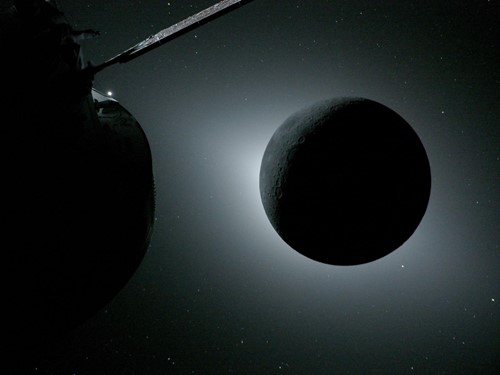
Artemis II

In Greek mythology, Artemis is the twin sister of Apollo — goddess of the Moon, the hunt, and the wilderness. NASA chose the name deliberately: where Apollo proved we could reach the Moon, Artemis is about going back to stay. A new chapter — more ambitious, more inclusive, and built for the long term.
All the images below are accredited to NASA and we thank them for sharing them with the world.
Artemis II Lifts Off
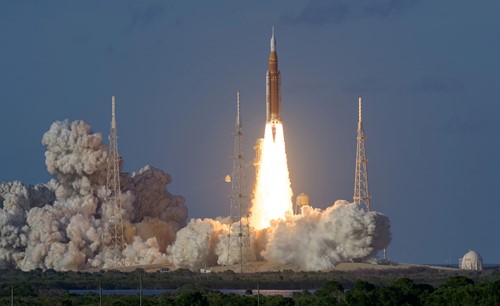
Artemis II launched from Kennedy Space Centre, Florida, on 1 April 2026 at 6:35 pm EDT (11:35 pm BST) — the first crewed mission to travel to the vicinity of the Moon in over 50 years.
The four-strong crew: Commander Reid Wiseman, Pilot Victor Glover and Mission Specialist Christina Koch (all NASA), joined by Mission Specialist Jeremy Hansen of the Canadian Space Agency — the most diverse crew ever sent toward the Moon.
"Hello, World"
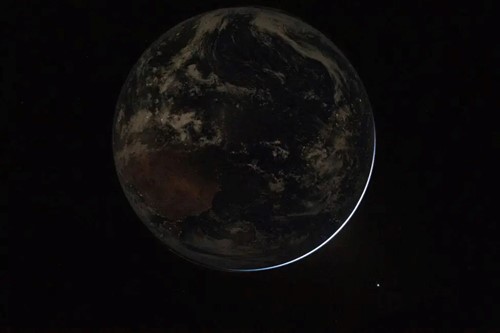
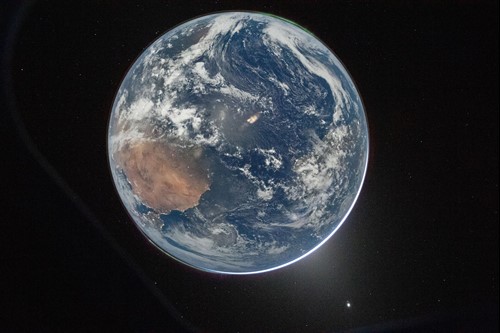
The day after launch, Commander Reid Wiseman photographed Earth from Orion's window following the translunar injection burn — the moment the spacecraft broke free of Earth's orbit and headed for the Moon. Titled "Hello, World", the image shows our planet and its atmosphere eclipsing the Sun. In the bottom image which is enhanced you can see the vast expanse of the blue Atlantic Ocean. The orange is the western Sahara. One of the most remarkable photographs of Earth ever taken from space.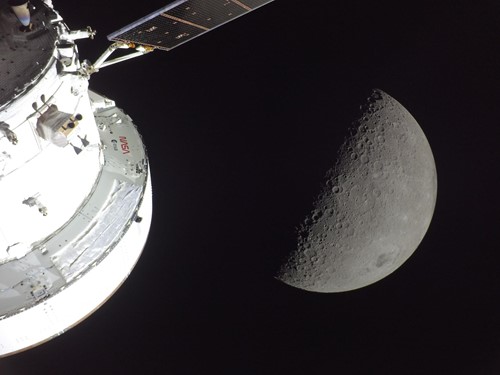
Sunlit Orion appears in the foreground with a first quarter Moon behind, illuminated from the right. Near the Moon’s lower right edge, the Orientale basin stands out, featuring dark ancient lava at its centre. This 600-mile-wide impact crater, ringed by mountains, spans both the near and far sides. This was taken with a GoPro camera mounted on one of Oriona solar arrays.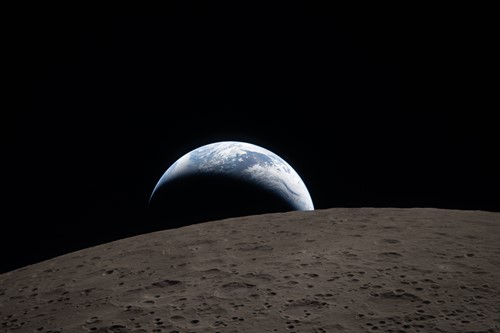
Earthset seen from Orion on April 6, 2026, during Artemis II’s lunar flyby. A blue Earth with white clouds sets behind the Moon; its dark side shows night, while daylight highlights Australia and Oceania. In the foreground, Ohm crater features terraced edges and central peaks formed by impact rebound of liquefied surface.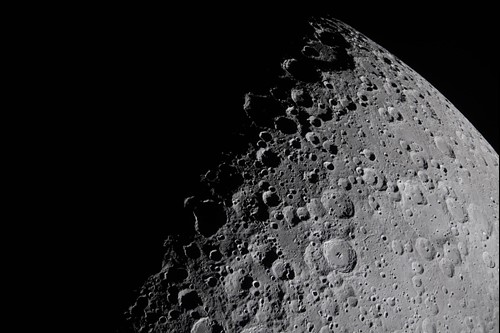
The Artemis II crew imaged the Moon’s terminator, where low sunlight casts long shadows, enhancing surface detail. Craters including Jule, Birkhoff, and Stebbins stand out alongside rugged highlands. Captured three hours into lunar observations on day six, during the far-side flyby, the lighting reveals terrain complexity unseen under full illumination.