Smart Telescopes
One of the most exciting developments in amateur astronomy in recent years has been the arrival of affordable smart telescopes — compact, automated instruments that combine a telescope, camera, mount and computer into a single self-contained unit, controlled entirely from a smartphone app.
What is a smart telescope?
Unlike a traditional setup requiring separate mount, camera and software, a smart telescope handles everything automatically. Set it up, connect via Wi-Fi, pick a target in the app and it does the rest — locating the object, tracking it across the sky and stacking images in real time to build a detailed photograph. No eyepiece, no laptop, no complex polar alignment.
Popular models
The ZWO Seestar range is currently the most popular entry-level option, with the S50 and the more compact, lightweight S30/S30 Pro both proving extremely popular. The S30 in particular has found favour as an ultra-portable travel instrument, while the S50 offers a slightly larger aperture for those wanting a step up in capability. A solar filter version is available for all three, making them equally useful for solar observing.
The Dwarf 3 and Dwarf Mini from DWARFLAB are similarly portable and app-controlled, with the Dwarf Mini being an ideal travelling companion.
What can they see?
Smart telescopes excel at deep-sky objects — nebulae, galaxies and star clusters — producing colourful results that would have required thousands of pounds of equipment just a few years ago. The Orion Nebula, Andromeda Galaxy, Pleiades and Horsehead Nebula are all well within reach. Most models also handle the Moon, planets and the Sun with an appropriate filter.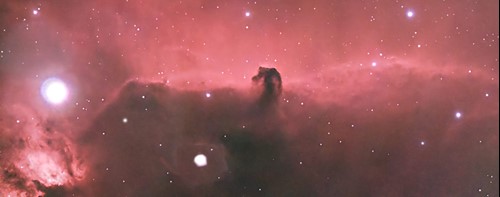
This image shows IC 434 "The Horsehead Nebual". this was taken by one of our members Ian. This being the second image he took with a Seestar S50.
What are the limitations?
The relatively small aperture — typically 50mm or less — limits fine detail compared to larger traditional instruments, and the focal length is fixed meaning you cannot zoom in or change magnification as you can with a traditional telescope. Experienced imagers with larger setups will still produce technically superior images — however if smart telescopes get more people outside and engaging with the night sky, that can only be a good thing.
Are they right for you?
Smart telescopes are ideal for anyone wanting impressive results without a steep learning curve — whether you have limited time, limited space, or simply want a grab-and-go instrument for dark sky sites. They are also brilliant for outreach events, where a live accumulating image of a nebula on a phone screen never fails to stop people in their tracks.
At RAG we are seeing a growing number of new members joining our Astrophotography Group with smart telescopes as their first imaging instrument — and the results speak for themselves. Perhaps more tellingly, several of our most experienced imagers have also picked one up as a travel rig, leaving their main setups at home when heading to star parties and foreign travel. When seasoned astrophotographers choose to pack a Seestar or Dwarf over their serious kit, that says everything about how far these instruments have come.
Come along to one of our meetings or get in touch before you buy — we are always happy to help.