
Variable Stars and Double Stars
 |
Stars are constant — or are they? When we look up at the night sky, the stars seem fixed and unchanging. But look more carefully, and a fascinating story unfolds. A significant number of stars vary in brightness over time — sometimes subtly, sometimes dramatically — and amateur astronomers play a genuine and valued role in monitoring them. To find out more about this extraordinary type of star, why not join us. Members can visit the Variable and the Double Stars pages in the Members Section. |
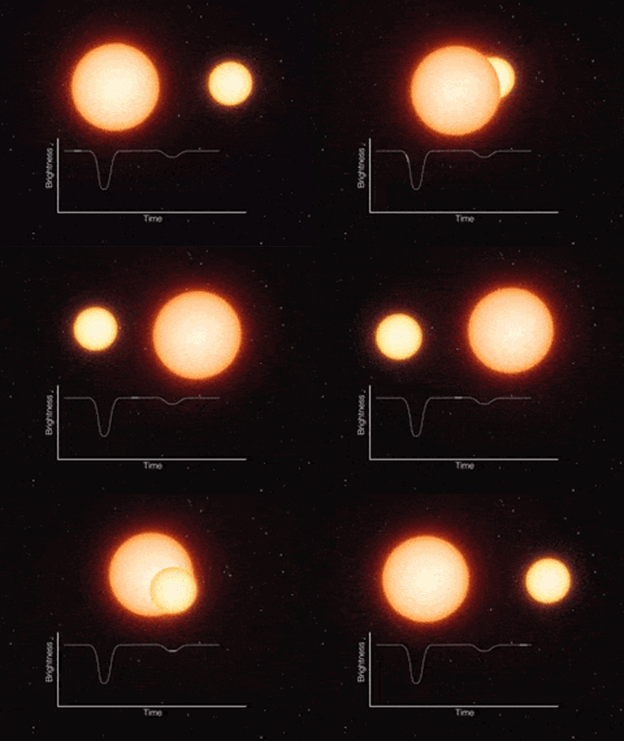
Variable Stars A star is classed as a variable if it appears to change in brightness as seen from Earth. The changes can come from within the star itself, or from outside — for example, light being blocked by an orbiting companion. The Schools' Observatory There are now more than 150,000 known variable stars, and the number keeps growing. Variable stars fall into three broad families: Pulsating variables physically expand and contract, changing in both size and temperature. The most famous are Cepheids — giant yellow stars that brighten and dim with clockwork regularity over periods of days to weeks. Cepheid variables are so reliable that astronomers use them as cosmic distance markers — the longer the pulsation period, the more luminous the star, allowing distances across the universe to be calculated. Space.com It was a Cepheid in the Andromeda Galaxy that allowed Edwin Hubble to prove, in 1924, that other galaxies exist beyond the Milky Way. Closer to home, Mira variables are cool red giant stars in the late stages of their lives. As these stars reach the end of their life cycle they become unstable and pulsate, expanding and contracting over periods of several months to a few years, changing in brightness by up to five magnitudes RASC — enough to go from naked-eye visibility to complete invisibility and back again. Eclipsing binaries are not intrinsically variable at all — they simply consist of two stars orbiting each other in a plane aligned with our line of sight, so one periodically passes in front of the other and dims the combined light we see. A classic example is Algol (Beta Persei), which dims and brightens predictably every 2.86 days — visible changes you can watch unfold over just a few hours. RASC Eruptive variables are more unpredictable — stars that flare, eject shells of gas, or undergo sudden outbursts. Even Betelgeuse in Orion, familiar to every stargazer, is a semiregular variable that made headlines in 2019 when it faded unexpectedly to its dimmest level in recorded history. Why does it matter? Amateur astronomers play an important role in monitoring variable stars and submitting observations to databases such as the AAVSO (American Association of Variable Star Observers) Space.com and the BAA Variable Star Section here in the UK. This is real science — your observations contribute to our understanding of how stars live and die. Useful links:
To find out more about this extraordinary type of star, why not join us. Members can visit the Variable and the Double Stars pages in the Members Section. |